
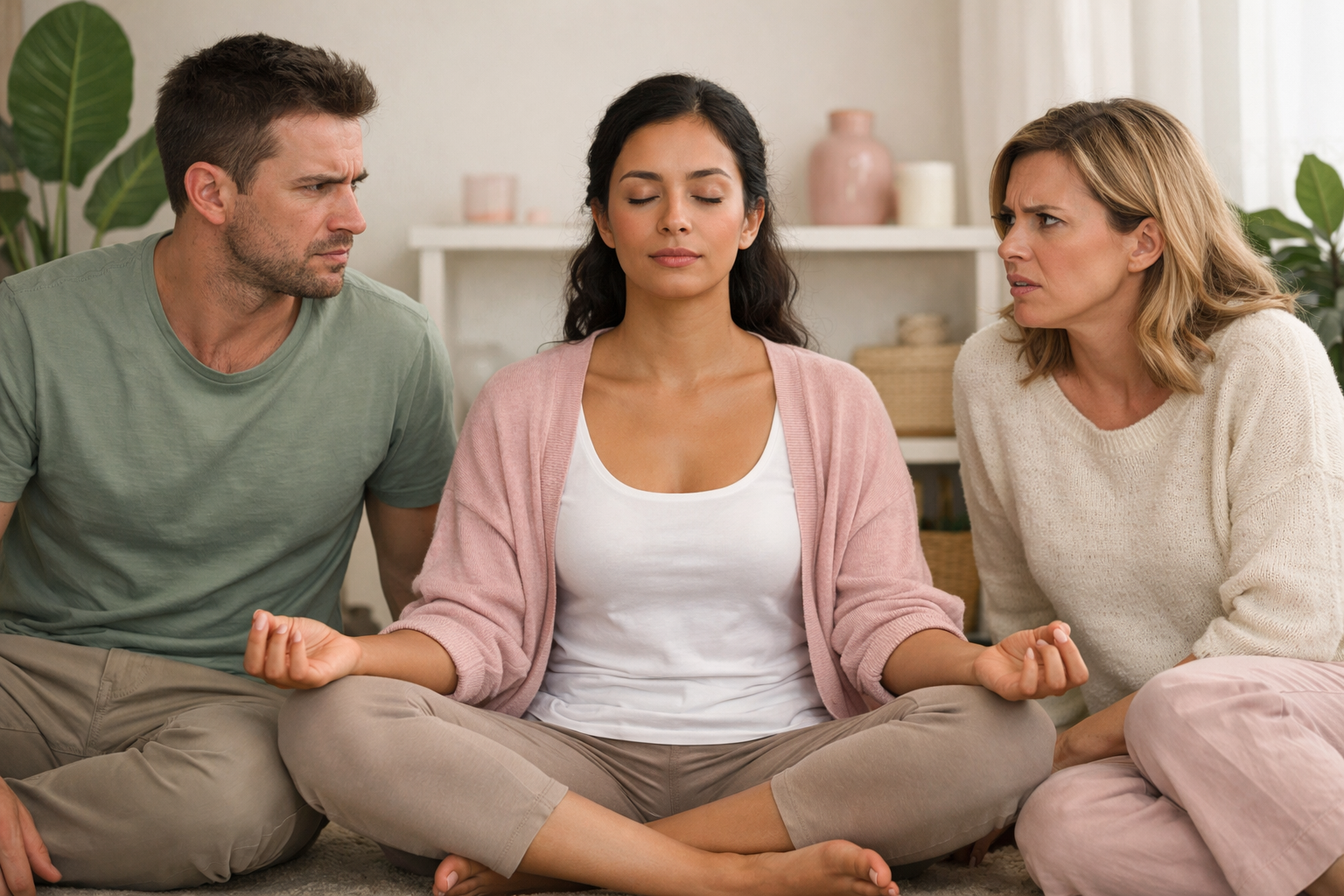
A mediator may meditate. As a matter of fact, I do. When I mediate, I don’t. Imagine I sat between you and your partner, meditating on your issue – while you watch and wait. No. I mediate your conflict. Here is the difference:
You and your partner have been going at each other for weeks. You probably can’t even remember what ticked the fight off. You avoid each other, don’t look into each others’ eyes, don’t touch each other. But there are those moments when you just want to sort it out. Get over it. Be heard. Be understood. So you try and explain yourself. But your partner feels that you are confronting them – that your words are loaded. While you speak, they interrupt you. Turn their back on you. Treat you with silence. And when they speak, you cannot listen – as you are overwhelmed by your own emotions, your position, your own truth. And they, by theirs.
What can you do?
Well, you can meditate on it. You step away from the sharp edges of the argument and turn inward. Your breath slows. One steady inhale, one deliberate exhale. And with it, the urge to defend, to interrupt, to win begins to soften. You let the anger speak silently and then pass, making room for what sits beneath it: hurt, fear, care.
In that quiet space, you feel your shoulders drop and your jaw unclench, and a different intention settles in. When you open your eyes again, you are still in the conflict, but no longer consumed by it; you are calm enough to understand, grounded enough to be heard, and present enough to let something new grow between you.
Yet an hour later, your partner opens the argument again, hurls accusations at you, may even become demeaning. Now you want to shout – why don’t you listen to my story? My pain? My needs? Can I please explain myself, can you please just sit and listen? Now be honest. Could you do that? Could you give your partner the same? Hand to heart.
This is where a mediator comes in
A mediator is that person you wish upon in a heated argument. That person who just watches and listens, makes sure both of you get the time to say whatever it is you need to say – without swearing, interrupting and shouting. Now that could be any third-party person, isn’t it? Like a neighbour, an older family member, a friend? Not quite so. You need someone who does not know any of you personally. No history. No connection. As a matter of fact, mediation is a profession that has to be learnt and practiced. While no human being can ever be completely bias-free, mediators are trained to be all-partial, non-biased, non-judgmental, non-advisory (depending on their style!), and to guarantee confidentiality.
Mediators give you what you crave the most: space and time to be seen, heard, understood. Not only do we give that to you, but also to your partner. You either sit in the same room with a mediator, or you participate in a conflict resolution session online.
- A mediator gives you both equal time: they listen to understand. Not to take sides – to understand.
- A mediator also gives you equal empathy: they hold the space for both of you without judgment, without prejudice.
- A mediator gives you the opportunity to find a resolution to your argument together – without doing that for you.
And the safer you feel in that space, the more easily you both start to breathe.
Not your cup of tea?
All of this may sound strange to you. Feely-touchy. Maybe you don’t want to stop fighting – perhaps you draw energy from it. Yes, while you are in the spiral of conflict, it may be how you feel. You can resolve it yourself, right? No need for strangers to listen in? Okay. And how far has that gotten you in life?
Maybe you want to give it a try. With each breath, a little more space opens up, and in that space comes the possibility of truly being heard. From there, mutual understanding is no longer forced or negotiated – it’s simply given room to emerge. Instead of holding your own position as the ultimate truth, you are starting to see your partner’s pain, fear, and point of view. Instead of finger-pointing at them, you start looking at yourself. Instead of blaming, you start taking responsibility for the situation and for the outcome you both want to achieve: a resolution to your argument. A newly found peace.
If you are holding a cup of tea, and someone bumps into you, and you spill that coffee – why did you spill that tea?
Because somebody bumped into you, right? No. You spilled your tea because there was tea in your cup. So – if you are in an argument, and your partner attacks you, and you explode- why did you explode? Because he attacked you? No. You exploded because of that “tea” – because of whatever you are carrying inside of you. Like anger, deep sadness, hatred, or fear.
If you are able to see that – then with your next argument, when your partner rubs you up the wrong way, you are able to spill something completely different: love, compassion, understanding. That is transformative. You may reach this stage of understanding by meditating. But a mediation of your dispute is more far-reaching, and lasting – as it involves the other party.
Need help with a dispute? Contact One World Mediators for online, virtual sessions anywhere in the world:

Alternatively, share your details and a short note and we take it from there:


Disclaimer: The only AI element in this blog article is the header image. The article is authentic, and written by Barbara Du Preez-Ulmi, founder of Leaders in Mediation,
Leave a Reply